Good things don’t come to an end. They spread….

Originally Published by the World Peace Foundation Reinventing Peace Blog

This post is the second of a two-part series on Somali piracy by Matt Herbert and David Knoll. 

Maritime piracy, thought by many to be a quaint relic of history, is booming. Modern-day buccaneers have upgraded from swords to AK-47s and spyglasses to GPS, but their motive remains the same: profit. Traditionally, pirate groups made a risk-reward calculation: operations that had higher earning potential also came with higher risk of interdiction. Somali pirates have upended this risk-reward tradeoff, by pioneering hijack-ransom piracy, a technique that minimizes their risk, while maximizing their profits. While successful, so far this type of piracy has remained limited to the waters near Somalia. This article will explore whether this innovative technique is poised to spread beyond the Horn of Africa.

Of late, the international community has found success in the fight against Somali piracy. Intensive efforts by an international naval flotilla in the western Indian Ocean, new protection efforts by shipping companies, and increasing chaos in Somalia have led to a dramatic drop in the number of Somali pirate attacks.
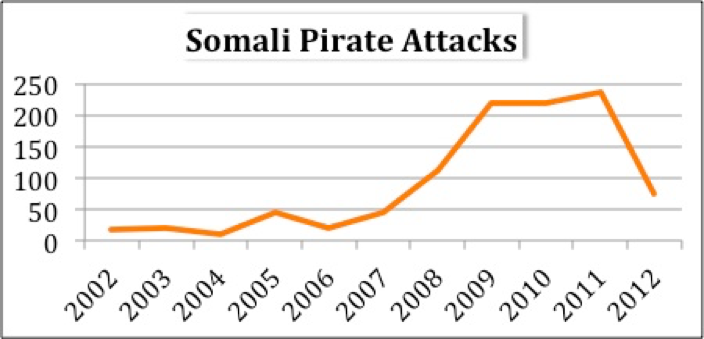
Somali Pirate Attacks

(Data from ICC/International Maritime Bureau – Piracy And Armed Robbery Against Ships Reports from 2004-2012)

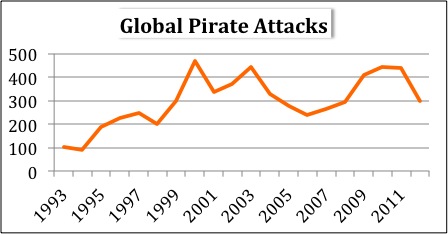
While an impressive and laudable achievement, the international community’s recent triumph has highlighted a concerning global trend: the rise of piracy in the 21st century. Over the last quarter century the number of reported acts of maritime piracy have tripled; the number of unreported acts is likely higher. The drivers of this increase are the mega-trends of the 21st century: trade, inequality, and geo-demographics. The globalization-driven increase in international maritime trade has increased the number of targets for pirates. Developing countries have experienced rapid economic growth associated with this boom, but the growth has been unequal, birthing a large dislocated population, bereft of opportunity, and thus willing to take risks. This massive group comprises the recruiting ground for potential pirates. Finally, there has been a dramatic increase of urban populations in littoral zones. The clustering of dispossessed populations in urban areas with easy access to maritime targets is acting as a long-term driver of maritime attacks. The presence of organized crime groups in many of these areas will help to ensure that piracy in the coming years will be well organized, professional, and difficult to stop.

Pic 2.png

(Data from ICC International Maritime Bureau – Piracy And Armed Robbery Against Ships Reports from 2004-2012)
The most financially lucrative form of piracy in the modern age has been hijack-ransom. While structural conditions – state weakness, existence of organized groups, and proximity to high value vessels – allowed the development of Somali piracy, it was their innovative technique that made them successful. Techniques can, and often do, spread, which begs the question: can ransom-hijack model piracy spread and if so, where?

Innovation diffusion theory is a useful framework for understanding how hijack-ransom piracy might spread. The concept explains how innovations proliferate through networks. There are five characteristics of an innovation that make it more or less diffusible: relative advantage, compatibility, trialability, observability, and complexity. Looking at the first four characteristics, hijack-ransom piracy comes out as easily transferable. The relative advantage—high profitability and low risk—is obvious. The technique is compatible with the practices and equipment available to most maritime criminal groups. And because it does not require extensive retooling in terms of gear, hijack-ransom piracy is trialable. A group can try this type of piracy and if they don’t like it, revert to their previous operational model without much lost investment. Lastly, the Somali style piracy is easily observable—it happens in the open and garners worldwide press coverage. Any group thinking of adopting the method will see numerous examples of the success of hijack-ransom piracy.

It is the last characteristic, complexity, which potentially hinders the diffusion of Somali-style piracy. The infrastructure necessary to support hijack-ransom piracy is more complex than is commonly assumed. In addition to the intricacy of the operations themselves, hijack-ransom pirate organizations require a number of key specialists, in addition to the foot soldiers that make up the bulk of the groups. They need negotiators to communicate with shipping companies to secure ransoms. Logisticians ensure that adequate food, water, and qat are available for a prolonged hostage situation. Finally, sustaining pirate operations, during the commandeering phase, and especially during the hostage state, is expensive, so investors are required.

The complexity of hijack-ransom piracy means that any diffusion of the technique must include the transfer of both tacit and explicit knowledge to potential adopter groups. Tacit knowledge is expert knowledge that is not easily expressed. For example this would include the knowledge of how to find a valuable ship, how to keep hostages alive, and how to negotiate with an international shipping company. Explicit knowledge is direct and easily expressed knowledge. Explicit knowledge is the operational knowledge an adopter could gain from reading a descriptive newspaper account of a pirate attack. Tacit knowledge, on the other hand, can only be transferred directly from an expert to a new user.

Knowledge is transferred through two types of communication channels: mass and interpersonal. Mass communication is unidirectional and reaches large, heterogeneous audiences. It includes such mediums as newspapers and television. Interpersonal communication is interactive and takes place between individuals or in small groups. Explicit information travels effectively and swiftly via mass communication channels. There has certainly been enough coverage of Somali piracy in the international press to provide a potential adopter with all the required explicit information. However, explicit knowledge alone is not sufficient: without tacit knowledge a pirate group will not have enough information to adopt hijack-ransom piracy. For innovation to spread, both explicit and tacit information must reach a potential adopter.

Tacit information is transmitted via interpersonal channels, which are interactive, allowing for back and forth between a potential adopter and a current user. Interpersonal interaction mostly occurs between people who know each other, or in other words, individuals or groups that share common characteristics: religion, ideology, ethnicity, or geographic proximity.

Therefore, in looking at the locations where hijack-ransom piracy could spread, one of the key markers is the existence of actors who have network connections to Somalia’s pirate groups. These actors are the ones that Somali pirates interact with most frequently and are positioned to receive the tacit knowledge necessary to adopt Somali hijack-ransom piracy. There are two likely networks through which Somali piracy might diffuse: the Somali Diaspora and Al-Qaeda linked groups. The Somali Diaspora is global, though it has concentrations in East Africa, Europe and the U.S. There is anecdotal evidence of connections between Al-Qaeda (and affiliates) and Somali pirates, and there is certainly enough circumstantial evidence to assume that information passes between the groups. Additionally, the areas of southern Somalia under Al-Shabaab control represent the largest area “held” by an Al-Qaeda affiliated group, and have attracted a host of international militants.

In addition to looking at areas with pirate-linked network presence, we also looked at areas with the structural conditions in place to support hijack-ransom piracy. These are: state weakness, existence of organized groups, and proximity to high value vessels. Pirate groups must have a secure area to organize and a harbor to secure the hijacked vessel without fear of interdiction. They do not require a completely failed state, merely ungoverned coastal territory in which they can operate unhindered.  The complexity of hijack-ransom piracy makes the presence of organized armed groups necessary for piracy to be effective. These groups have the organizational and financial capital necessary to carry out sophisticated hijack-ransom pirate operations. And most obviously, pirate groups must be located near high value shipping. Hijack-ransom piracy takes the revenue-generation capacity of a vessel hostage, so pirates need to be near not just international shipping, but high value vessels to make the enterprise worthwhile.

To find potential diffusion areas, we overlaid the two sets of vectors (structural conditions and Somali pirate networks) and looked for areas where all the factors intersected. We found four areas to which Somali piracy could potential spread. The first is in Southeast Asia, primarily in Indonesian, Malaysian and Filipino waters, which have a long history of piracy and a high concentration of global shipping. The region has several Al-Qaeda affiliate organizations, which have a history of sending personnel to various Al-Qaeda operational theaters. The second is the Gulf of Guinea, which has recently seen a spike in piracy, although thus far not the hijack-ransom variety. The region hosts a number of organized militant and piratic groups who would likely be interested in the technique, as well as the presence of Boko Haram, which is believed to have received some training in Somalia. The third is the Strait of Hormuz; however, the proximity of this area to Somalia increases the likelihood that pirates interested in operating around the Strait will opt for bases in Somalia. The last area is the Libyan coast, which is close to high value global shipping going through the Suez Canal. Despite being proximal to developed countries with powerful navies, Libya has all the factors to make it susceptible to hijack-ransom piracy: the state is weak, and there is a concentrated presence of organized crime groups, many of which are associated with Al-Qaeda. There is even a Somali Diaspora presence in the area associated with illicit maritime activities.

It’s important to highlight what this analysis is and is not. It is not intended to be a Magic 8 Ball, able to predict precisely if and where hijack-ransom piracy where emerge. Neither should it be read as an assertion that the Somali Diaspora, or, for that matter Al-Qaeda members, are all latent pirates. They are not. However, they do represent networks with strong internal communication that could facilitate the spread of knowledge between disparate regions. With this analysis, we have tried to think critically about how Somali model piracy could spread, what conditions may facilitate it, and the role of various networks in the diffusion of the innovation. The utility of pinpointing areas at risk – such as the Gulf of Guinea and Libya – is that it enables national governments and the international community to proactively work to mitigate the chance the technique might emerge. Sound policy and well-designed aid programs can address some, though not all, of the structural factors – state weakness and the ability of organized crime groups to operate with impunity – as well as some of the mega-trends – inequality and societal dislocation – which foster piracy in the first place. Such proactive policies are expensive, but they are a fraction of the tens of billions of dollars which hijack-ransom could annually cost the global economy.

Somalia’s Innovating Pirates

Originally Published by the World Peace Foundation Reinventing Peace Blog

By Matt Herbert and David Knoll

The MT Smyrni, a Liberian flagged Tanker, was sailing 250 nautical miles off the Omani coast when pirates were sighted. The pirates closed fast, attacking with automatic weapons. The crew was able to drive the pirates off once, but a second attack overwhelmed the Smyrni. Within moments the vessel had been commandeered, the 26 crewmembers kidnapped, and a new course set towards the Somali coast. The ship’s owners were contacted, ransom negotiation initiated, and its crew held hostage to hedge against attempts to forcefully free the vessel. Ten months later the pirates received $9.5 million dollars, and the owners of the Smyrni received their ship back.

The attack on the MT Smyrni is hardly unique. Over the last eight years, Somali pirates have emerged as perhaps the most successful maritime brigands of the modern age. Between 2005 and 2011, they hijacked 218 vessels and held 3,741 sailors hostage. Their operations peaked between 2010 and 2012, when roughly 3,000 Somali pirates extorted $429.37 million for the global shipping community.

Somali pirates operate well out into the Indian Ocean, extending from the Bab El Mandab Strait to the Maldives. In at least one case, Somali pirates were encountered off the south Indian coast. In an era of increasingly globalized and professionalized crime, Somalia’s pirates have demonstrated that opportunities for lucrative illicit gain still exist on the high seas, albeit without eye patches and peg legs.

Their attention grabbing, large-scale attacks served to remind the world that piracy is not dead, but has simply changed forms. Apart from the direct costs of the ransoms, shippers faced increased insurance premiums on vessels sailing past Somalia. In some cases, shipping companies chose to reroute vessels away from the western Indian Ocean all together, at considerable expense and time. Some estimates peg the annual impact of Somali piracy on the global economy at $18 billion.

The high cost of Somali piracy begs the question: how have they been able to achieve such success? Analyses of Somali piracy have focused on the structural dynamics in Somalia. The most frequently cited enabling factor is weak state authority. Minimal state presence allows pirates to organize and operate with little fear of arrest or interdiction. State weakness also impedes the growth of legitimate industries, incentivizing young men to turn to piracy.

Other analyses have focused on the availability of ships off the coast of Somalia. International shipping relies heavily on the Suez Canal and Bab El Mandab Strait as a shortcut from the Mediterranean to South and East Asia. Add in the tankers moving oil from the Persian Gulf to South and East Asia, and the waters of the Western Indian Ocean are packed with all manner of high value vessels. Despite the threats posed by Somali pirates, it is economically prohibitive for most shipping companies to reroute their cargo, ensuring that prey remains aplenty for pirates.

These structural factors are important in explaining the emergence of Somali piracy, but they are ineffective in explaining its economic success. Somali pirate attacks regularly yield million dollar payoffs. By comparison, pirates in other areas of the globe are often lucky if they can get ten thousand dollars. The main driver of this differential is the innovative nature of Somali pirate operations.

Traditionally, pirates hijacked vessels to steal money, cargo, the ship, or kidnap individuals onboard. These methods all involve a risk-reward tradeoff. Stealing shipboard items such as money or small amounts of cargo is low risk, but not lucrative. Alternatively, trying to steal an entire ship and reregister it is lucrative, but unlikely to be successful and could involve state violence. A large proportion of pirate attacks are basically opportunistic crimes – one or two pirates slipping on board an anchored vessel, stealing money or goods from the ship, and rapidly fleeing. The pirates perpetrating such attacks are generally unorganized and unskilled.

Somali pirates, by contrast, are highly organized groups of men who hold specialized skills. The Somali model is encapsulated in the MT Smyrni episode. Pirates use motherships — often hijacked fishing vessels — and small skiffs to stalk vessels steaming through the Indian Ocean. Once spotted, the pirates use speed and violence to swarm the target and take it over. It is then steered back to the Somali coast, where the vessel’s owner is contacted and a ransom demanded.

The detention of the vessel’s crew creates a hostage situation, deterring attempts by military forces to regain control. Instead major shipping companies pay the ransom quickly to ensure the safety of the crew and to get the ship back into revenue generating status. Once the ransom has been paid, the vessel and its crew is released, and the pirates return to the sea try again.

While the Somali model of piracy involves aspects of traditional operational models of piracy, including vessel hijacking and crew kidnapping, it differs in how it leverages value from its victims. Instead of having to engage in the messy task of selling a vessel, or the non-lucrative seizure of the currency aboard, the Somali pirates have realized that simply extorting international shipping companies can garner large profits. The companies in turn are incentivized to negotiate by the high value of the ships seized, the physical threat to the crew, and the significant cost of their vessel being idled. The cost of an idle vessel can be particularly acute, with some estimates putting the daily cost at $17,500 for a bulk carrier.

The hijack-ransom is shocking in its simplicity and impressive in its profitability. What makes this method effective is not simply the enabling conditions, but the innovative operational methods that have been introduced. The recent success of the international community to slow Somali piracy might convince some that the threat has been removed, however the factors that produced hijack-ransom piracy are in place in other regions indicating that Somali-style piracy could be poised to spread. A forthcoming post will address how hijack-ransom piracy might proliferate.


Amphetamines, Anarchy, and Assad

Originally Published by the Global Initiative Against Transnational Organized Crime, Available Here.

As Syria’s bloody civil war boils on, the nation has become fertile ground for the growth of criminal activity.  As we described in the August AOC brief, Syria has become a regional hub for weapons smuggling, the illicit trade in antiquities, and now drug trafficking.  Recent reports have begun to emerge from Syria that amphetamine laboratories are being discovered in cities such as Homs, while drug traffickers in Lebanon have highlighted the ease with which they are able to smuggle drugs through the country. The chaos, poverty, and greed of war-torn Syria heightens the likelihood that such activities will grow in scope, financially benefitting criminals and combatants while drowning the region in narcotics and exacerbating the fragility of both Syria and its neighbours.

While several types of drugs are smuggled through Syria, the one currently raising concern is captagon. Captagon was the brand name of an amphetamine type stimulant, sold commercially until it was banned in 1986. Apart from the name, the current incarnation of the drug shares few chemical similarities with the original. Modern, illicitly produced captagon is usually composed of amphetamines cut with a mix of adulterants. The drug’s popularity has grown rapidly in the last decade, primarily in Saudi Arabia and other Gulf countries where it is taken as an energy booster and aphrodisiac. The value of the captagon market is massive, and increasing. Individual doses sell for $20 in Saudi Arabia; with some estimates pegging the number of captagon tablets successfully smuggled into that country at over 500 million.

While captagon has been popular in the Middle East since the 1980s, high levels of demand for the drug didn’t take off until the early 2000s.  Initially, the market was supplied either by laboratories in southeastern Europe – primarily in Bulgaria, though laboratories were also uncovered in Slovenia and Serbia. The drug was then smuggled through Turkey, Syria, and Jordan before being sold in Saudi Arabia. By 2006 captagon laboratories began to appear in Turkey, including two uncovered in Gaziantep on the Turkish/Syrian border. Unconfirmed reports suggest that Syria began producing captagon that same year, while in 2007 Lebanon seized both precursor chemicals and the laboratory equipment for producing the drug.  Also by this time 75% of the global illicit production of captagon’s chemical precursor was shipped to “two countries in the near and Middle East.”

Wherever it was being produced, by 2006 captagon had started to flood Saudi Arabia. In that year, Saudi Arabia seized 12 tons of the drug; roughly equivalent, as the UN Office of Drugs and Crime dryly noted in the WDR 2009, to “to the sum of all UK seizures – the biggest amphetamine market in Europe – from 2000 to 2006.” In Syria, the level of captagon seizures doubled between 2007 and 2009, to 22 million tablets. Most trafficking routes still moved overland through Syria and into Jordan, though there are some indications that a route through Iraq was active by 2010.

The Syrian civil war has entrenched the nation’s role as an entrepot for the Middle East’s amphetamine market. Labs have been uncovered in Syrian cities such as Homs, as well as in northern areas held by insurgent groups. As well, an increasing number of Syrians have been arrested throughout the Middle East for captagon smuggling. While it is unclear which groups are involved in the production and smuggling of the drug, it is likely that both the Syrian regime and at least some of the rebel organizations are financially benefitting. The patchwork nature of territorial control along traditional smuggling routes likely force traffickers to pay tolls or bribes to both sides. One apparent benefit for the traffickers is that the dire economic straights of Syria’s law enforcement and military personnel have apparently made bribery, and thus smuggling, far easier.

It is possible that Syria could evolve into a thoroughfare for other types of narcotics as well. Cocaine trafficking, and a small domestic cocaine market, developed in Syria during the 2000s, with 77 KG of the drug seized in 2007.  Heroin seizures also grew dramatically during the 2000s, averaging 80 KG/year between 2007 and 2011.  For drug traffickers, Syria is a geographically well-positioned staging ground not only for the Middle East’s amphetamine market, but also for Europe’s far more lucrative cocaine and heroin market. The smuggling networks that bring weapons in and humans and antiquities out of the country could well be used for narcotics trafficking. The focus by both the insurgents and the government on perpetuating the stalemated civil war lessens the likelihood that any sort of meaningful action will be taken to halt the trade in drugs.

Out of Sight, Out of Mind: Barclay’s Bank Kiboshes Somali Remittances

Originally Published by the Global Initiative Against Transnational Organized Crime, Available Here.

In May, Barclays Bank announced it would be withdrawing banking services from 250 money transfer services, including a number that provided remittance services to Somalia and Somaliland. This was the last western bank serving Somalia.  Barclay’s rational for the service termination revolved around the weak internal controls against money laundering and terrorist finance many of the businesses reportedly had.

In reality, it is more likely that it was a fear of risk that motivated Barclays to act. Over the last decade, anti-money laundering regulations have become increasingly strict. In recent years, financial regulators have moved aggressively against banks handling “dirty money”, often levying massive fines for non-compliance. The $1.9 billion settlement HSBC reached with the U.S. this August, has prompted an increasingly risk averse banking community to minimize their exposure to businesses deemed to be potential money laundering and terrorist finance threats.

Anti-money laundering (AML) efforts are a tricky balancing act for banks. At a base level, AML efforts necessitate that exercise due diligence in providing banking services and implement “know your customer” (KYC) rules.  The challenge for many remittance services is that many users, and especially recipients, do not possess the official identification necessary to meet KYC requirements. Being unable to guarantee that those who engage in remittance activities via their banking partners are not laundering money or funding terrorists, banks have opted for the extreme option and excised them from their banking systems.  A report by Thompson Reuters issued this month offers a pragmatic, risk-based approach to KYC requirements.

In taking this decision, Barclay’s may have mitigated the risk that it faces, but its actions will have significant consequences for the economy, development and thus stability of Somalia, whose future is again looking more fragile.  This stems of the importance of remittances for senders and receivers, as well as the size of the economic flows. Somalia alone receives $1.2 billion in remittances annually. Many Somali families depend on remittance to supplement their incomes.  Furthermore, this decision is in fact only minimally effective, or possibly even counter-productive, in the broader battle against money laundering and organized crime. Given the importance of the remittance flows, there is little chance that the Somali diaspora will cease sending money simply because the legal channels are withering away.  Instead they will turn to informal, often untraceable money remittance systems – such as hawalas – to support their families in Somalia.

The shift from formal, traceable systems – despite their flaws – to untraceable channels hinder the efforts of FIUs and law enforcement agencies to identify and trace actual terrorist and criminal finance. It may even provide a benefit to criminal actors, as the new channels for otherwise licit remittance funds pulsing through the informal challenges will overwhelm and camouflage the far smaller number of illicit transactions. Thus, Barclay’s decision has produced few winners – not the migrants, the remittance receivers, nor law enforcement agencies. In an ironic twist, the only beneficiaries appear to be Barclay’s itself and the international criminals and terrorists that it ostensibly acted to impede.